Navigating the Holidays as a Transracial Adoptee: A Guide for Adoptees, Partners, and Parents
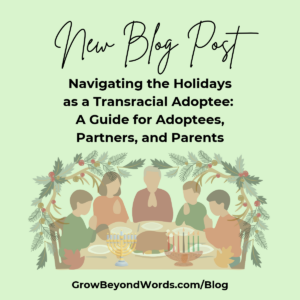
The holidays are often described as a time of togetherness, connection, and belonging. Images of families gathered around dinner tables, sharing traditions, laughing over familiar stories, and celebrating their connections can create expectations about what family togetherness is supposed to look and feel like. But for transracial adoptees of color, holiday gatherings can bring up experiences and emotions that are much more complicated.
For adoptees who are people of color growing up in predominantly white adoptive families, extended family gatherings can be particularly challenging. You might find yourself surrounded by grandparents, aunts, uncles, cousins, and other relatives who all look like one another, while you are the only person who looks different. Even when family members love you and consider you an important part of the family, that doesn’t necessarily mean they understand your lived experiences as a person of color or the unique complexities of being adopted.
Sometimes the differences are obvious. You might notice that everyone else shares physical characteristics, cultural references, family histories, or experiences that you don’t. Other times, the differences show up in smaller, more subtle ways: a relative making an uncomfortable comment about your appearance, someone asking an intrusive question about your adoption, a family member dismissing something you’ve experienced related to race, or the expectation that you participate in traditions that don’t reflect your cultural background. And sometimes, the hardest part isn’t anything anyone says or does. It’s simply being in a room where everyone else seems to belong in a way that feels less accessible to you.
These experiences can bring up feelings of loneliness, grief, frustration, resentment, disconnection, or even guilt. You might love your family and genuinely enjoy spending time with them while also feeling exhausted by the emotional work of navigating your differences. You might look forward to certain holiday traditions while dreading the people, conversations, or expectations that come with them. It’s important to recognize that being included in a family gathering isn’t the same as feeling understood, affirmed, or fully seen. And being loved by your family doesn’t mean you are obligated to overlook comments, tolerate uncomfortable situations, or continually explain experiences that others haven’t taken the time to understand.
As the holidays approach, here are some considerations and suggestions for adoptees, their partners, and their adoptive parents to help navigate these gatherings with greater awareness, compassion, and intention.
For Transracial Adoptees: You Get to Decide What Works for You
One of the most important things to remember is that you have choices. Family traditions, holiday expectations, and other people’s feelings do not automatically create an obligation for you to attend every gathering or participate in every activity. You can love your family and still decide that certain environments aren’t healthy or comfortable for you. You can appreciate an invitation without accepting it. You can enjoy spending time with some relatives while choosing to limit your time with others.
Give yourself permission to evaluate each situation individually.
Rather than automatically saying yes because it’s what you’ve always done, consider what you actually want and need. Ask yourself:
- Which family members do I genuinely enjoy spending time with?
- Are there people or situations that consistently leave me feeling hurt, excluded, or emotionally drained?
- Do I feel like I can be myself around these relatives, or do I find myself masking, minimizing, or managing other people’s discomfort?
- Am I attending because I want to be there, or because I feel guilty about what might happen if I don’t?
- What would make this gathering feel more manageable or meaningful?
You don’t have to make an all-or-nothing decision. Maybe you attend dinner but skip the extended afternoon gathering. Maybe you visit one side of the family but not the other. Maybe you make an appearance for an hour rather than spending an entire weekend. You can also decide that staying home is the healthiest choice.
Prepare for conversations that might be uncomfortable.
Unfortunately, holidays can create opportunities for comments or questions that bring adoption and racial identity differences to the forefront. You might encounter questions about your birth family, comments about how you look different from everyone else, assumptions about your cultural background, or statements that minimize racism or your experiences as a person of color. You are not responsible for educating everyone, but having a few responses ready can help you feel more prepared.
For example:
- “I’d rather not talk about my adoption right now. Let’s enjoy the holiday.”
- “That comment actually makes me uncomfortable.”
- “My experience with race is different from yours, and I’d appreciate it if you didn’t dismiss it.”
- “I know you might not intend it this way, but that question feels intrusive.”
- “I don’t think you realize how that sounds from my perspective.”
You can also choose not to respond at all. Changing the subject, stepping away, or declining to engage in a conversation is a perfectly acceptable response.
Create an exit strategy.
If you decide to attend a gathering, think ahead about what you might need if things become uncomfortable. Drive separately if possible, arrange a check-in with someone you trust, identify a quiet place where you can take a break, or decide in advance how long you want to stay. Give yourself permission to leave if the situation becomes too much. You don’t need to wait until you are overwhelmed or someone else agrees that your discomfort is justified.
Seek connection outside the gathering.
Sometimes the most meaningful holiday support comes from people who understand your experiences without requiring you to explain them. Connecting with other adoptees of color, friends, or supportive communities can help you feel less alone. Consider making plans with people who affirm your racial and cultural identity and understand the complexities of adoption. And perhaps most importantly, remember that you do not have to choose between loving your family and honoring yourself. You deserve relationships in which you can experience both belonging and authenticity.
For Partners of Transracial Adoptees: Support Without Making Them Explain or Defend Themselves
If your partner is a transracial adoptee, the holidays may involve emotional experiences that you don’t fully understand or personally relate to. You might see a family that is welcoming, loving, and excited to spend time together, while your partner experiences the same gathering very differently. You may not notice the subtle comments, racial dynamics, or adoption-related expectations that make these gatherings difficult. You might not understand why a seemingly harmless question feels hurtful or why your partner needs time to recover after spending a few hours with extended family. Your role isn’t to fix every uncomfortable situation or fully understand every aspect of your partner’s experience. It’s to approach those experiences with curiosity, validation, and a willingness to offer support.
Ask what support looks like before the gathering.
Rather than assuming your partner wants you to intervene, ask what would feel helpful. Would they like you to redirect uncomfortable conversations? Speak up if a relative makes a racially insensitive comment? Help establish a time limit? Check in periodically? Leave together if things become overwhelming?
These conversations are especially important because different adoptees have different preferences. Some may want their partner to speak up immediately, while others may prefer to address things privately or handle the situation themselves.
Don’t minimize or dismiss their experiences.
Comments like “They didn’t mean anything by it,” “That’s just how your family is,” or “You know they love you” may be intended to reassure, but they can leave your partner feeling even more isolated. Intent and impact are different things. A family member can have good intentions and still say something hurtful. Your partner doesn’t need to prove that a comment was offensive or explain why something felt uncomfortable before you take their experience seriously. Try responses like:
- “I can understand why that was uncomfortable.”
- “I’m sorry you had to deal with that.”
- “Would you like me to say something next time?”
- “What would feel most supportive right now?”
Be willing to advocate, even when it’s uncomfortable.
If a relative makes an inappropriate racial comment, asks an intrusive adoption-related question, or dismisses your partner’s experience, consider whether you can help interrupt the interaction. Sometimes a simple statement from someone who shares the family’s racial identity can make a difference. For example, you might say, “I don’t think that’s an appropriate question to ask,” or “I don’t think we should dismiss what they just shared.” Don’t automatically leave your partner to manage the emotional labor of addressing family members, particularly when those family members are your relatives.
Recognize that your partner may have mixed feelings.
Your partner might genuinely enjoy parts of the gathering and still struggle with other parts. They might want to see certain relatives but not others. They might feel connected to their adoptive family while simultaneously experiencing grief, disconnection, or reminders of racial and cultural differences. Try not to interpret their discomfort as rejection of you or your family. And remember that supporting your partner doesn’t end when the gathering is over. They may need time to decompress, process an interaction, or reconnect with people and spaces where they feel understood. Offer that space without expecting them to immediately move on. Ultimately, your partner needs to know that they don’t have to navigate these experiences alone or prioritize everyone else’s comfort over their own.
For Adoptive Parents: Help Your Child Feel Seen, Not Just Included
For adoptive parents of children of color, the holidays can be an opportunity to demonstrate what it means to create an environment where your child feels genuinely welcomed, understood, and affirmed. You may have wonderful memories of family gatherings and deeply meaningful traditions. You may feel that your extended family loves your child unconditionally and considers them just as much a part of the family as everyone else. Those things matter. But they don’t automatically address the racial and adoption-related experiences your child may be navigating. Your child can feel loved by your family and still feel different. They can enjoy holiday traditions and still experience reminders that their racial identity, cultural background, and adoption experiences are not shared by the people around them. The goal isn’t to eliminate every difference or make every gathering perfect. It’s to make sure your child knows that their experiences matter and that you are willing to recognize and address the challenges they encounter.
Prepare your extended family before gatherings happen.
Don’t wait for your child to experience an uncomfortable interaction before addressing expectations with relatives. Talk with family members ahead of time about appropriate and inappropriate questions, comments about physical appearance, adoption-related conversations, and the importance of acknowledging racial differences. Explain that your child should not be expected to answer personal questions about their adoption, birth family, or cultural background simply because relatives are curious. It’s also important to address racial comments and stereotypes, including those that might be framed as jokes, compliments, or harmless observations. Don’t put the responsibility on your child to correct relatives or educate them about race and adoption. That is an adult responsibility.
Don’t assume that treating everyone the same means everyone feels equally included.
You might believe that your child is simply another grandchild, niece, nephew, or cousin, and that everyone is treated equally. While equal treatment may be your intention, your child’s experiences may be very different from those of their relatives. Consider the ways that racial differences might show up during family gatherings:
- Does your child have opportunities to see people who share their racial or cultural identity?
- Do family members understand that your child’s experiences with racism may be different from their own?
- Are cultural traditions from your child’s heritage acknowledged and respected?
- Do relatives make assumptions about your child’s personality, interests, abilities, or experiences based on their race?
- Does your child have to navigate questions about their adoption that other family members never have to answer?
These aren’t necessarily problems that can be solved during one holiday gathering. They are opportunities to consider how your family can become more aware, responsive, and inclusive.
Listen without becoming defensive.
As your child grows, they may express frustration about extended family members, holiday traditions, or experiences of feeling different. They may tell you that something a relative said was hurtful or that they don’t want to attend a particular gathering. Resist the urge to immediately defend your family or explain why someone didn’t mean to cause harm. Instead, listen. Ask questions if they want to talk. Validate their feelings, even when their perspective differs from yours. Statements like “I hadn’t thought about how that might feel for you,” “Thank you for telling me,” and “I want to understand what would make this easier” can help your child feel that they don’t have to protect your feelings when discussing their own experiences.
Respect their choices as they get older.
As children become teenagers and adults, they need increasing autonomy in deciding how they want to engage with extended family. They may want to attend some gatherings and skip others. They may want to establish boundaries with particular relatives or create new holiday traditions that feel more meaningful to them. Try not to interpret these decisions as rejection of you, your family, or the traditions you have created together. Your child should not have to attend gatherings simply to make you or other relatives feel better. Their emotional well-being matters more than maintaining appearances or preserving traditions without question.
Make room for racial and cultural connection beyond the holidays.
One of the most important things adoptive parents can do is recognize that their child’s racial and cultural identity needs don’t disappear during the holidays—or any other time of year. If your child is the only person of color in your extended family, consider how you are creating opportunities for them to build meaningful relationships with people who share their racial or cultural identity. This includes friendships, community connections, mentors, cultural experiences, and spaces where they don’t have to explain or justify who they are. You cannot change the fact that your child may be the only person who looks like them at a family gathering. But you can make sure they have other places where they experience connection, affirmation, and belonging. And you can demonstrate through your own actions that being a supportive adoptive parent means continually learning, reflecting, and being willing to challenge family members when necessary.
Moving Toward Holidays That Make Room for Everyone’s Experiences
There is no single way that transracial adoptees experience the holidays. Some genuinely enjoy large extended family gatherings and feel deeply connected to their adoptive families. Others experience significant discomfort, loneliness, or disconnection. Many experience a combination of these feelings, sometimes changing from year to year or even from one gathering to the next. What matters is recognizing that the experience of being adopted into a family doesn’t automatically mean feeling connected to every member of that family. And being part of a family that looks different from you can create unique experiences that deserve acknowledgment rather than dismissal. For adoptees, you are allowed to make decisions that honor your needs, even when those decisions disappoint other people. For partners, you can offer meaningful support by listening, validating, and being willing to stand alongside your partner when uncomfortable situations arise. For adoptive parents, you have an ongoing responsibility to create family environments where your child’s racial identity and adoption experiences are recognized, respected, and supported.
Belonging is about more than receiving an invitation or having a seat at the table. It’s about being able to show up as your authentic self without having to minimize, explain, or defend important parts of who you are. As we move into another holiday season, let’s consider how we can create family gatherings that make room for the full experiences of transracial adoptees, not just the parts that are comfortable or familiar to everyone else. Everyone deserves to experience the holidays in ways that feel safe, meaningful, and connected. And sometimes, creating that experience means changing traditions, having difficult conversations, setting boundaries, or choosing a different way to celebrate altogether.